I think he,
once mentioned how the strongest plants were those that found their way toward the light at the end of the crack.
Those that grow beneath the asphalt and seem to pierce through it, no matter how cold and heavy that gray may be, or how infertile everything becomes beneath a vast mantle of decay.
What he might have forgotten to mention, perhaps,
is that few of them ever bloom.
And in the end,
they are all called weeds
*Ruderal Def. es un término que se utiliza en biología para referirse a plantas capaces de crecer en ambientes alterados u organizados por el humano, como zonas urbanas, ruinas o terrenos abandonados.
About the work
The series “Velos en concreto” seeks to foster a space for reflection on the urban-natural context that surrounds us, using it as an introspective analogy to view aspects of denial through a different lens. Each work, as well as the series as a whole, is a self-portrait and a response to the chaotic and misunderstood aura that I have felt present at various moments in my life and throughout most of my childhood.
Exploring the relationship between ruderal nature and so-called weeds on one hand, and the urban environment on the other, may seem conflicting at first glance, but it is nothing more than a symbiotic relationship that expresses itself in different ways. The questions I kept in mind when creating the selected images, mentioned in the description, were: What do we choose to hide, cover up, and cut out of our lives? and, How do we relate to events that do not unfold as we have planned?
Reflection on the process and layout:
The works were initially shaped in my mother’s (a ceramist) studio, and the metal frames supporting the large-format pieces were constructed with the help of the person with whom my father (an iron sculptor) used to weld and build his works. Provenance, process, and place played an important role in the creation of the pieces, which ultimately serve as self-portraits.
Regardless of the technique used to create them, all the works in “Velos en Concreto” share a repetitive element. They all utilize a mold to standardize the format and adhere to a set of shared parameters.
Arranging the paintings in a grid allowed the public to get both a panoramic view of the work and a more detailed perspective of each piece. With this in mind, I did not use this specific layout for the exhibition merely for aesthetic reasons; I also drew on the symbolic connection to the way we impose structures and patterns on ourselves and others. Grids can suggest the idea of an order and regularity that are seemingly useful, but they can also be interpreted as a form of control and limitation. In this sense, the linear arrangement of the pieces can be seen as a reflection on how the structures that surround us rigidly influence our perception of the world and our decisions.
From an early age, we are exposed to visual patterns that teach us to understand and categorize reality in a particularly productive way. In the case of school classes, for example, we are seated row after row, desk after desk, and individually confined within the enclosed space of a square. This linear organization may have been useful for controlling student behavior and maintaining an environment conducive to learning, but I struggled with this organizational approach for quite some time. In any case, this way of relating to space became ingrained in my mind and is evident in many of my graphic and material decisions today. For example, in the formats I choose for my works and the way I exhibit them.
Furthermore, the grid also has a connection to architecture and construction, an aspect that intertwines with concrete as the support and substrate for the pieces. The grid-like arrangement suggests the idea of a planned and systematic construction, delving into the perceptual inquiry of how this influences our understanding of reality.
In addition to these works, I created large-format panels that symbolically represent mirrors. They show how our reflection is composed of multiple fragments that harmoniously blend linearity and organic forms. This breaks with the idea of a single, organized truth that we often impose on our experiences and ways of being. Instead, it proposes the existence of cycles and facets, similar to those found in the ever-changing life of weeds. By presenting a fragmented image, the work also allows the viewer to actively participate in the creation of the complete image and to reflect on their own perception of the image as a concept. The images revealed in these mirrors show us versions of ourselves, different each time we look.
I was exposed to Japanese culture from a young age, as my mother discovered her passion for the arts and ceramics within that wonderful Shinto-Buddhist world. The way she works with materials to highlight the authentic finishes in her pieces has always captivated me, and both the patina and raw materials hold an important place in my work. Hence my fascination with Wabi-Sabi. The concept of Wabi-Sabi is a philosophy and aesthetic approach that originated in Japan; it focuses on the beauty of imperfection and the transient nature of materials. This philosophy can be applied in many areas, including art and the curation of exhibitions themselves.
In the context of the exhibition and the artwork, certain techniques aligned with the values of Wabi-Sabi can be used to highlight the beauty in imperfection. One of the defining principles of this movement is the refusal to hide processes, errors, cracks, or tool marks. These characteristics can be displayed and become an integral part of the artwork.
Both the Wabi-Sabi aesthetic and this exhibition share the characteristic of revealing what is typically concealed. Beauty in imperfection and the raw, unadorned materials are both hallmarks of the Wabi-Sabi style and are evident throughout the work. By revealing these imperfections and processes, a more authentic connection is created with the viewer, allowing for a deeper and more meaningful appreciation. Furthermore, this form of presentation not only allows for a more sincere appreciation but can also be seen as a way of celebrating humanity itself, with all its imperfections and constantly evolving processes.
Finally, another equally important factor that was taken into account is the repetition in the arrangement of the pieces. Because there are so many of them, this repetition is powerful, and I use it as a metaphor. It represents how society causes us to adopt similar patterns of thought and behavior, which can limit our creativity and our ability to think outside the box.
Proyección y virtualidad dentro de la obra:
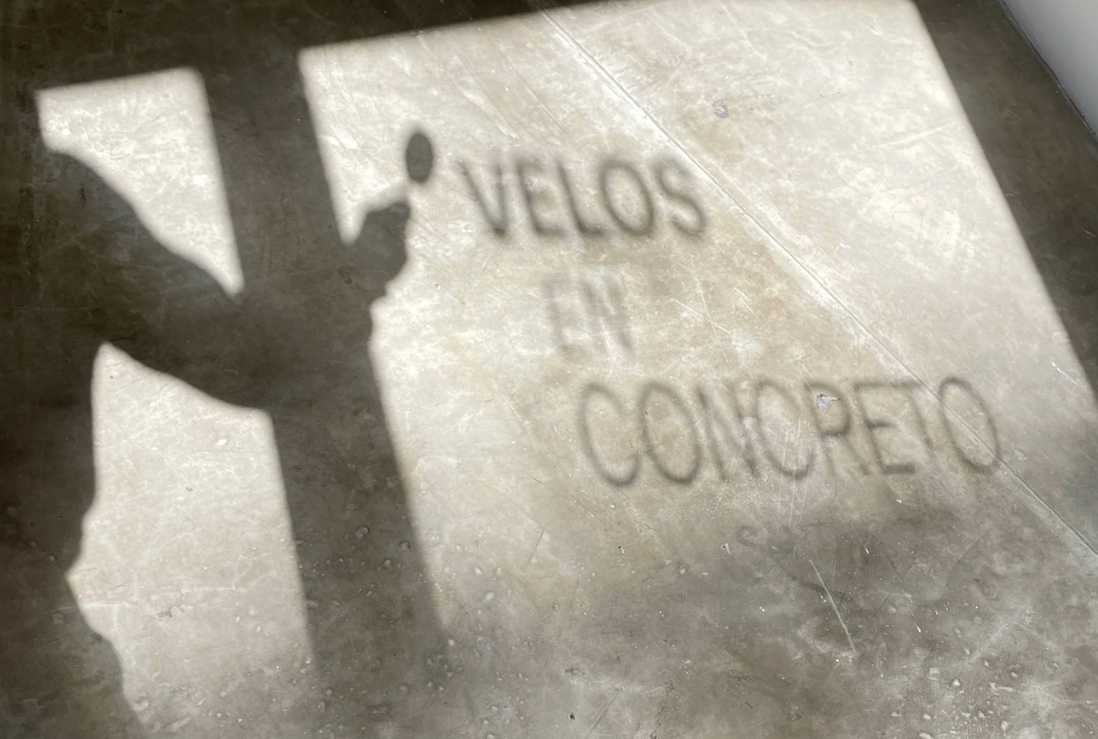
The use of various physical formats is definitely one of the exhibition’s strengths; in addition to these, the artist utilized digital media to create an ephemeral, hidden, non-printed image. One of the videos included in the exhibition’s formats shows the gradual emergence of an image on a concrete slab projected in a loop; the repetitive nature of the projection evokes the cyclical life of the weeds themselves. It shows us, time and again, what emerges and what is concealed. Both the projected image and the substrate (in this case, the slab) are veils of reality expressed visually. Light is the first and most important element of an image; it conceives it and allows it to exist. This is why, when we project the video onto this slab, we illuminate a gray, rectilinear, and barren plane, and bring movement to life.
Among other digital tools, there is a white screen framed in iron that, at first glance, appears to show nothing. However, when the viewer looks at it through a viewer designed specifically for the work, parts of an image of undergrowth can be seen, which is also present in its medium-format counterpart.
About the Act of Observing
The concept behind the entire series is rooted in the act of observing what is usually hidden, uncovering details that lie unnoticed. Magnifying glasses are available in the gallery to help viewers appreciate the details in the smaller formats, while the digital work comes with its own viewer, which reveals the latent image when held close to the screen. These tools invite the public to immerse themselves in a world of subtleties and discoveries, revealing vast worlds in detail and visual information that would otherwise remain invisible.
The physical act of leaning in and looking through a viewfinder or magnifying glass carries significant weight in itself, and in a way serves as a gateway to the world of the hidden, celebrating and acknowledging its value. It is through this gesture that we instantly pull back a curtain and immerse ourselves in the infinite world that has been patiently waiting to be discovered.
Social, political, and territorial context:
As a work that originated in Bogotá, the project is situated within a social and cultural context marked by complexity and diversity. The city is a melting pot of identities and experiences, where different realities and ways of life coexist. In this context, my work takes on a particular meaning, since as a disorganized person who identifies with weeds, I find myself in a modern, paved, and organized world that sometimes feels alien to me and difficult to understand.
The work, therefore, becomes a reflection on the relationship between human beings and their environment, on how modern society often insists on imposing its order and logic on nature, on the simplest and most spontaneous forms of life. In this sense, my work seeks to question the ways in which social reality is constructed and to highlight the importance of valuing the diversity and complexity of human experiences.
In this dichotomous political context that Bogotá and the entire world are experiencing, my work seeks to demonstrate that it is possible to consider and coexist with different positions and ways of thinking. I seek to reconcile my identity as a weed in a defined and organized world, and to demonstrate that coexistence between the natural and the structural is possible. I hope my work can inspire others to consider and accept differences rather than exclude or marginalize those who think and live differently. It has taken me time to understand, but I believe it is true that sometimes we play the role of the grid and other times that of the weed. By turning these material spaces into increasingly necessary channels, I aim to call for empathy and recognition.