La Cumbrera: This refers to a páramo mountain located in the village of “El Verjón Bajo” in the upper basin of the Teusacá River, where this project is being carried out. “It is the peak that marks the eastern end of Calle 72, rising from an elevation of 3,260 meters above sea level.” (Ospina & García, 1998b). Today it is a nature reserve, where a project called “Parque Museo del Páramo” once existed. This land is adjacent to the workshop and the house where the physical development of this work takes place; this complex is named “El Umbral” (The Threshold).
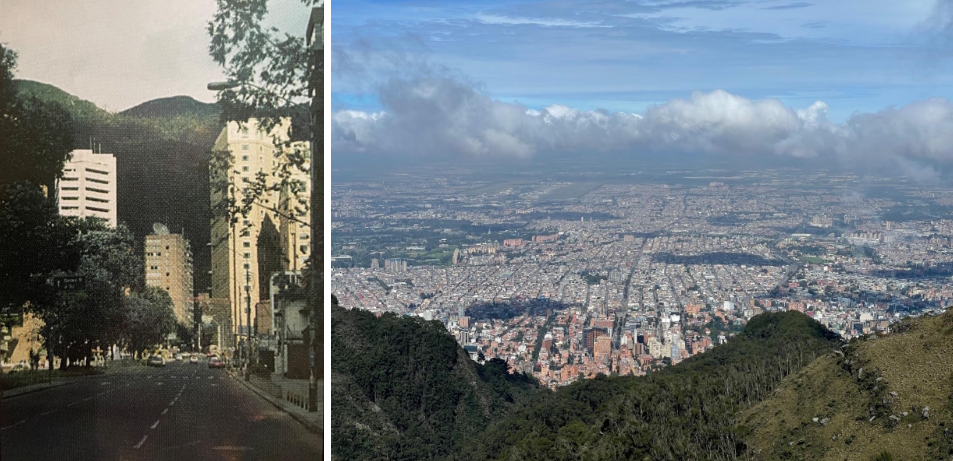
Foto: Diego Samper cerca de 1997 Foto: Santiago Riaño 2023
- Introduction
The beyond has always held a profound fascination for me. I reflect on the veil that both separates us and gives us; on duality as an intrinsic condition of existence; and on how to name that which divides us.
This work is a dialogue with a mountain in the páramo range of Bogotá, one that keeps watch through the fog and gives form to its essence through spirits.
- La Cumbrera
La Cumbrera, located thirty minutes from the city, is a reserve situated in the rural area of “El Verjón Bajo”, within the upper basin of the Teusacá River.
There is a rock from which much of the city can be observed. A constant murmur can be heard, a sea of chaos: the city breathes below, and at times a distant alarm rises without barely ever breaking the calm of the listener. The site opens like a majestic, V-shaped threshold, a natural fold that both connects and delineates the city and the mountain. My father jokingly called it “seventy second and zero. (A colloquial way to indicate an address in Bogotá)”
Today, listening to that name again in all its precision, I like to think of it as a place that precedes and observes. A space in the eastern hills that surround the city, prior to the circunvalar road, marked by the invisible axis of that seventy second street as it points upward toward the place from which the work draws its inspiration.
This high mountain, as all of them, is wise and transforms at will, allowing us to see only as far as she chooses; sometimes we wander aimlessly through curtains of fog, and other times, from the hills of Bogotá, we manage to catch a glimpse of the “Nevado” peaks to the northwest. It’s not uncommon to feel mesmerized by the translucence of the cool, bluish-gray hues. I always associate these with stillness, for since I was a child I have been convinced that this mountain captures time, only to release it momentarily on a clear, sunny day.
More than twenty-five years after setting foot there for the first time, I remain certain that a cyclical reality and a sense of permanence exist there.
The meeting of dusk and night casts a cold veil over the mountain and its neighbor, the city. The sunset brings its gloomy hues, and with them I am always overcome by a sense of abandonment. The birds return to their nests in a flurry, knowing that silence will gradually overtake them. That moment of the day is by no means foreign to me; I somehow link it to the night my father died. That feeling took root in my life for a long time, evoking a fragility and a brittle coldness that visits me at that hour of the day, right there on that mountain.
Ever since I was in my mother’s womb, I’ve been going up to La Cumbrera. I don’t see it as a mountain road where I have to stay alert while driving, but rather as that automatic route I trust when returning home. No one ever gets lost in their own backyard. That’s why I aim for the photographs I take to create this work to be sincere and intimate. They carry their own code and frame feelings. They must not conform to technical standards or be planned in any way, for in that case they would correspond more to mechanical and distant processes, not to their spontaneous and authentic origin.
- El Umbral
In Shintoism, thresholds hold deep spiritual and symbolic meaning. These gateways mark the entrance to the sacred grounds of a shrine, signifying the boundary between the physical and spiritual worlds. The act of crossing a threshold also represents transition and the overcoming of challenges, both spiritual and mundane.
– The Threshold – is the name of the space where the pottery studio and the house my mother built are located. Adjacent to the ridge, they are designed to honor a holistic and spiritual approach to work, representing a way of understanding techniques and materials. In this sense, the studio becomes a sanctuary where human creativity and the essence of the mountain converge. Each piece reflects not only artistic skill but also a deep connection to the earth and its eternal cycles, reminding us of our interdependence with the natural world and paying tribute to its beauty and harmony.
At the “Umbral” complex, I feel as if the mountain is watching me through the window, as if ghosts were surrounding me, and for a while, I thought I was the only one. A late-night phone call, the kind I sometimes have with a Swedish friend who once visited “El Umbral” in Colombia, revealed the opposite. She told me, “You know? I feel like there are spirits looking through the windows; I’ve always felt a strong energy in that house.”
That night I understood that the intrigue of wondering if there is something we cannot see, of knowing if there is something watching us from the other side of that fogged-up glass, lay at the heart of the work and responded to a collective mystery.
- Scopaesthesia
Scopaesthesia is the phenomenon in which a person, through extrasensory means, senses that they are being stared at.
As the fog lifts and the evening shadows lengthen, a previously hidden presence begins to be felt. At first, the sensation of being watched frightened me, as if something were lurking. Today it intrigues me, and the work itself enters my life as a way to capture and translate this sensation into tangible form. This feeling, known as scopaesthesia, not only unsettles me but also connects me deeply with my surroundings.
Every time I climb La Cumbrera, I feel that there is something beyond the visible, an energy that responds to my presence and my gaze. It is as if the mountain itself were engaged in a silent dialogue with me, where every observation becomes an act of reciprocity and synchronicity. In those moments, the act of looking transcends simple contemplation: it becomes an intimate interaction in which my being and the essence of the mountain intertwine, revealing a spiritual connection that goes beyond the physical.
- Synchronicity
I decided to dust off an orange box from the old “Kodak 290 Web System,” lost in memories of the nineties. This wasn’t just any box: it didn’t hold the camera, since I have it on display on a shelf in my room. The box was filled with neatly organized cardboard envelopes. Today I call them “the archive.”
Stumbling upon the archive felt like a divine encounter, a moment of profound revelation that made me believe in the synchronicities of the universe. Discovering my father’s photographs was like striking up a conversation with ghosts. We could understand these memories as spectres. The images he captured were identical to the ones I had taken, even though I had never seen them. The spots on the mountain where he had worked were the same ones I immersed myself in, almost thirty years later. These moments when the past and the present connect so perfectly reinforce my belief that there is an invisible force that nourishes the process and helps guide these encounters.
- Representation
Since the images in this project seek to transcend mere visual documentation of the moorland, aiming to capture its deepest essence, I do not replicate traditional depictions of the frailejones. Instead, I pursue a representation that embraces their metamorphic nature. Each frailejón is not merely a plant, but also a living symbol of change and continuity, an entity in a perpetual state of transformation. My work reimagines these beings in their various states, from sprouting to decomposition, revealing the multiple facets of their existence. Thus, the work does not dwell on external form but penetrates the vital flow that animates the páramo, offering a vision that is both a meditation on permanence and a celebration of its constant becoming.
In my work, clay becomes much more than a mere medium. It is the vessel that channels an essence, a tangible support that holds open a window to the ethereal. As I work with it, the memories and energy of the moor are infused into it, transforming it into a living medium that stands tall and vibrates with the very vitality of the landscape. This process not only captures the visual character and aesthetic system of the environment but also encapsulates its spirit, creating a palpable connection between the physical and the spiritual. Clay, with its texture and malleability, acts as a bridge, allowing the experiences and essences of the moor to materialize and become tangible.
The layering of elements in the photographic technique I use is much more than a mere aesthetic strategy: it is a way of weaving together stories and relationships. Each layer represents a moment, a memory, an observation, creating a visual mosaic that reflects the complexity and depth of introspective exploration. By combining images, colors, and textures, I capture not only the external appearance of the subjects but also their multifaceted essence. This technique allows the photographs to engage in a dialogue with one another, merging time, space, and narrative. It is a way of capturing the interconnection between the past and the present, the visible and the invisible, the tangible and the ephemeral. Through this process, the layers become a metaphor for the different spheres of life, each influencing and enriching the other, weaving a web of meanings that invites deeper, more personal contemplation.
7.Duality
A significant part of the conceptual framework of the work lies in its dichotomous nature, portraying the divided essence of the spaces it depicts. This dualism manifests itself in the various contrasts I explore: dusk and night, the city and the mountains, metal and nature. The passage of time as organisms settle upon the rock, for example, captures the tension and harmony between the temporal and the eternal, the organic and the inert.
This dichotomous reality that I explore in my work is a reference to a tool present within consciousness itself: its comparative ability as a means of discernment. This innate capacity to distinguish between opposites is fundamental to understanding the world around us.
In the work, this duality becomes a reflection of the human mind, which constantly navigates between what is and what is not, what is seen and what is intuited. By exploring contrasts in the work, I show how consciousness uses these differences to construct an understanding of existence.
- Dead and Matte
In the studio, and in all my works, I have a phrase I use to describe how I like my pieces to look: “All dead and matte.” This preference stems from a deep appreciation for materials at a particular stage in their life cycle, associated with their “death”, where wear and tear. The passage of time, and the effects of exposure to their surroundings are most evident.
These elements imbue the process with sincerity and authenticity, as they allow for a raw, unadorned image of the process itself. The resulting effect evokes a visual sensation similar to patina and creates a soft finish on the work. This gives me an aesthetic pleasure that I surely developed as a child, growing up in a workshop where the metal being worked on was always rusting and the bisque-stage ceramic tones were abundant.
Cracks have been a recurring theme that has always been present. They are a way of highlighting the process without hiding or glossing over it. These fissures not only expose vulnerability and wear, but also celebrate the importance of the passage of time, and their presence represents the very act of living.
Now I suspect that those same cracks in a work that aims to serve as a window may actually indicate that it is nothing more than a mirror. Thus, rather than offering a representation of the outside world, each fragment of the broken mirror may be reflecting back to us a fragmented image of ourselves, forcing us to find in that reflection some of our many facets and beauty within them.
9.“Imagen Mundo”
I couldn’t think of any other way to wrap up this account than by mentioning what a friend told me during the later stages of the first season of this series. An extremely sensitive, empathetic person, and above all a true aesthete when it comes to imagery and narrative: Scaramouche. This reflection, as heartfelt and profound reflections often do, took me by surprise and moved me in many ways.
“You have many layers, you see? Cinema is like that; when you edit it, you can move from a memory to the present, to the future, to a dream—you can blend that dream with that memory.
You can insert a person who wasn’t there.
That’s where the image-world begins to take shape; it’s the moment when you’re seeing something and can’t tell the difference between reality and fiction.
The ethereal begins to become the world, and you can’t tell if what you’re seeing is dead or alive.
And that’s it—my grandfather is there, but my unborn son could be there, and your father is there.
All the layers are interacting in the same space, and you only achieve that when your sensory-motor connections are weakened: when the matter ceases to be rational. This is produced by madness, delirium, or dreams… Thoughts are mixed up in that shower, with an object that passed through your father’s life…”
Theoretical Framework:
Aby Warburg, with his theory of “Nachleben” or the afterlife of images, offers an essential perspective for understanding how the photographs I have taken of the moor for use in this project resonate with those once captured by my father more than twenty years ago. These images bear a striking resemblance to those older ones, revealing a visual and symbolic continuity that transcends time and makes me deeply believe in the permanence of being. This phenomenon underscores how certain symbols and landscapes retain their evocative power across decades, not only as visual representations but as bearers of deeply rooted cultural and personal meanings. The modern images, though technologically advanced, continue to reflect the essence and memory of the place, acting as bridges between the past and the present.
In the context of the modern world, the artist plays a crucial role in reconnecting society with spiritual experiences that have been largely forgotten or severed following the loss of the gods and secularization. This spiritual disconnection has left a void that artistic practices can help fill, creating new forms of interaction and understanding of the intangible. In my work, ceramic windows emulate these teachings and experiences in the mountains, functioning as thresholds toward a deeper perception of reality. By using traditional materials and techniques in combination with contemporary approaches, these pieces seek to transcend mere aesthetics to become vehicles for reflection and contemplation, inviting the viewer to reconnect with a lost spiritual dimension. The work not only documents the essence of the páramo but also acts as a sacred space where memory, identity, and spirit can coexist and be revalued in our modern society.
In the creation of my work, I find a resonance with Marcel Duchamp’s “Green Box,” a significant precedent in art history that also used the format of a box to encapsulate and present complex ideas. The “Green Box” not only contained a series of notes and studies related to his “Large Glass,” but also functioned as an artifact in its own right, challenging traditional notions of what constitutes a work of art. Similarly, my project takes the form of a box that not only holds the book and other elements but also serves as a symbolic container for the experiences, lessons, and memories related to La Cumbrera and its archive.
His “Green Box” was used to immortalize and convey his most intimate and abstract thoughts, much like my box, which seeks to evoke a series of feelings and reflections that bring the reader closer to the essence of the work. This artifact acts as a sort of time machine, creating a space in which the memory and soul of the project can be explored and contemplated. The choice to present the work in a box is not merely an aesthetic gesture, but a statement about the nature of art as a container of deeper experiences and meanings. In this way, the box not only protects the physical elements of the project, but also allows the work to resonate with the viewer on a deeper emotional and conceptual level.
The philosophy contained in The Tibetan Book of Living and Dying has inspired me to view life as a cycle of transformation, a perspective that resonates deeply with my experiences in the mountains. This vision of life and death as integral parts of a whole has helped me come to terms with my own experiences of loss and find a way to honor those memories in my work. Throughout the process and its conceptualization, the project is guided by specific moments and experiences with death, in a way narrated like the book itself and segmented by stories in the same manner.
Waste Management:
The collection of fibers to make paper from frailejón leaves is carried out with the utmost care. Leaves are collected individually, selecting dead leaves lying on the ground that have begun to decompose.
In the project’s waste management, special attention is paid to sustainability and respect for the reserve’s natural environment. The process of making frailejón paper uses a solution of water, sodium carbonate, and frailejón leaves. Although this mixture is slightly alkaline, we take steps to adjust its pH before disposal. Through controlled acidification, we adjust the solution’s alkalinity, ensuring that the resulting water is safe for irrigating the house garden. This approach not only minimizes environmental impact but also recycles waste in an eco-friendly manner, integrating the creative process with sustainability practices and environmental stewardship.
Additionally, regarding the management of the “vein” or excess fiber from the frailejón that is unsuitable for papermaking, it is used to create dyes that become part of the artwork, contributing the colors and textures sought upon its completion. Once this process is complete, any leftover material is turned into compost. In this way, we close the material usage cycle, ensuring that nothing is wasted and everything returns to the earth in a beneficial way.
There are two important points regarding the material process and the collection of clay. The first is that the artist personally collects the clay by hand in small quantities; no machinery, extraction chemicals, or a group of people are used for this purpose. The second is that no abrasive chemicals are used to process it (only feldspar and sand), with proper handling and within the enclosed space of the workshop. Neither of these materials causes harm to the environment.