Farragos definition
Del lat. farrāgo ‘mezcla de varios cereales para forraje’, ‘mezcolanza, conjunto de cosas desordenadas’, ‘cosa de poco valor’.
- m. Pile of messy things.
Curatorial text
Urban Farragos (Fárragos en lo Urbano) invites viewers to immerse themselves in an aesthetic and conceptual field that enables a deeper contemplation of Bogotá’s language. The project draws attention to overlooked places, textures, and symbols, offering a visual reading of the codes that construct the city’s identity. Centered on notions of disorder and perceived insignificance, the work foregrounds what is often excluded from view.
Within this framework, the concrete slabs hold images the way a negative film does: unselected, reversed, and often dismissed, containing frames that would rarely be chosen for positivization. Alongside the veils, these elements appeal to the unconscious, opening a space where memory lingers in its raw, unfiltered state and reconnects with the environments we inhabit.
About the work
“Fárrago” from Latin “farrāgo” means ‘a mixture of various grains for fodder,’ ‘hodgepodge, a collection of disordered things,’ ‘something of little value.’
In Bogotá, we find a mix of different architectural styles and aesthetic surfaces that intertwine within an apparent disorder. If we manage to see through this jumble and confusion; we can discover a beauty in the language, inherent to a living and ever-changing city that nourishes us with images as fodder does and becomes etched into our collective unconscious. We are immersed in layers of urban palimpsest, stains, smog, cracks, and peeling paint, among other things that constantly overlap.
The work maintains a close relationship with concrete, which, as the image’s support, acts as a symbol. This is why I use a technique that imprints the image onto the slab without obscuring the noise and information with which it is forged. This technique is a postmodern reinterpretation of classical painting, as it separates the medium from the pigment present within it and uses the former to transfer the image to the substrate, representing two of the miracles of the 20th century in the process: concrete and affordable digital printing.
The way I approach photography in this project is neither traditional nor particularly technical, as I use my cell phone, which allows me to maintain a certain spontaneity in the essence of the photo. I have a sincere connection with this tool which, in this case, is intimate and always with me and it has become an extension of my journey through the city. The creation of images exists on a passive and reflective plane; I do not intend to interact with what is captured. On the contrary, I simply wait for a frame that is usually driven by a memory lost in the past. There is nothing apparent or obvious happening in the image, only an unconscious call to immortalize a connection and a feeling present in the moment.
With this in mind, it is worth noting that the captured images are negatives of the unconscious etched onto the material plane. Some are sharper than others. They are a representation of the unconscious and are displayed in negative, alluding to photographic film, to the image before it is specifically selected and then developed and printed. That is why I work with the volume of the plates, as a collection of rolls that have not yet been chosen and brought to the stage of developing the consciously selected image. This is why these plates not only hold collective value, but also represent an intimacy and a raw selection of images that are not typically sought in curatorial practice.
The material process is a postmodern reinterpretation of classical painting and image-making on traditional media. In this case, since the photograph is taken with a cell phone, it travels as RGB data bits before being stored and subsequently printed as a physical image via a low-quality black-and-white photocopy. Obtaining this series of images at such a low cost and with such easy access is undoubtedly something that changes the notion of reproducibility and materiality of the image for any generation born after the late 20th century, when it was invented; it is a peculiarity that completely alters the way we manipulate image and text in postmodernity.
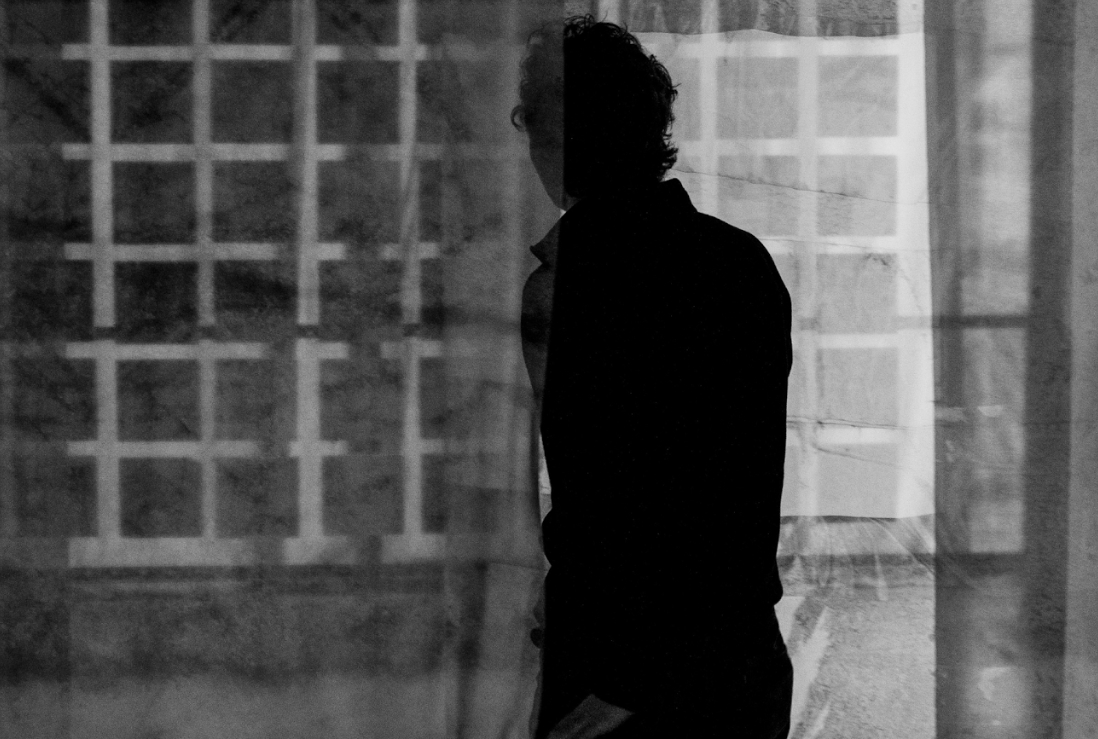
In the context of the veils, the symbolism undergoes a significant shift; the image acquires duality, allowing for interpretation both right-side-up and upside-down within the space. Similar to a palindrome, these representations offer a reading that makes sense in both directions. Many of these veils encapsulate the city’s diverse layers, which intrinsically allude to the urban palimpsest mentioned at the beginning of the text. This superimposition ranges from political propaganda to popular cultural advertisements, including mystical and religious posters. This fabric speaks to our culture and our city without needing to explicitly show subjects or actions.
The depth of the veils in the room varies in translucency depending on the time of day, creating a sense of a shifting atmosphere. This phenomenon reflects a common feature of Bogotá, where a sense of constantly changing depth of field is experienced throughout the day.
Once the work is displayed, these two types of media (the veil and the concrete slabs) are exhibited in the same space, and the dialogue between the feminine and masculine forms becomes evident. On one hand, the masculine image is represented on a rigid medium arranged in rectilinear, logical grids; in the case of the veils, the form is organic and fluid, as well as cyclical in terms of its translucency.
“And it is in the midst of our madness that we conceive a tied-up pole, many sharp walls, and various tiles that release when stepped on; but what’s most surprising is how we accept and nurture ourselves amid the seemingly endless layers that pile up.”